Dr. Gymbro
←

#heart rate variability

2 articles
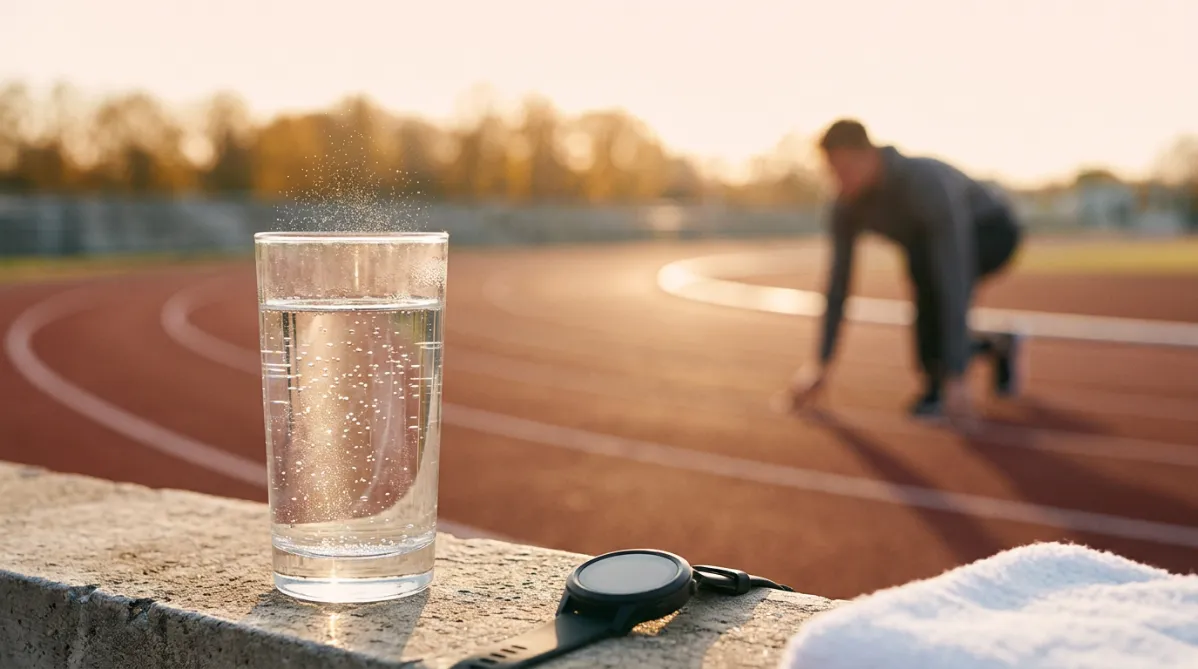
A wide, editorial-style photograph of a clear glass of water on a weathered concrete ledge at the edge of an outdoor running track, shot in soft golden-hour light. Tiny, fine bubbles cling to the inside of the glass and drift upward, catching warm backlight so the water looks luminous and crisp. The glass is about three-quarters full, with delicate condensation beading on its surface. In the softly blurred background, the curved lanes of a terracotta-red track sweep diagonally across the frame, with faint white lane lines leading toward the horizon. A lone sprinter in a charcoal athletic top crouches in a starting position, out of focus, rendered as a muted silhouette. Long shadows stretch across the track, and a hazy line of trees glows amber in the distance.

Foreground details are sharp: a matte black sports watch rests beside the glass, its screen dark, and a folded white towel sits at the edge of the frame. The palette is warm and restrained, with terracotta, sand, soft peach sky, charcoal, and the cool, clean glint of water as the focal accent. Shallow depth of field, 85mm lens look, fine film grain, gentle natural lens flare from the low sun. The composition follows the rule of thirds, with the glass placed on the left third and generous negative space on the right for headline text. The mood is calm, athletic, and modern, like a contemporary health and performance magazine cover, with no text, logos, or futuristic elements.
science research

Eau hydrogénée avant les sprints : puissance maintenue et récupération accélérée

BY DR. GYMBRO ·

Un verre de 280 mL d’eau enrichie en hydrogène, bu environ une minute avant des sprints à pleine intensité, a permis de garder une puissance plus élevée dans une récente étude croisée. Les athlètes ont également montré une récupération de la variabilité de la fréquence cardiaque plus rapide, et le taux de lactate sanguin était environ 1 mmol/L plus bas trois minutes après l’effort. Toutefois, l’étude ne portait que sur 13 hommes, était simplement simple‑aveugle et n’a testé qu’une dose aiguë. Voici ce que les chercheurs ont trouvé, comment ils l’ont dosé, à qui cela pourrait convenir, et pourquoi il faut rester prudent.

A wide, editorial-style still life photographed on a pale warm-gray concrete surface in soft, diffused morning window light. On the left side, a tall clear glass filled with deep magenta-crimson beetroot juice sits beside two halved raw beetroots, their concentric rings of vivid fuchsia and purple clearly visible, with a few small green-and-red-veined leaves draped casually nearby. On the right side, a matching clear glass of cloudy white creatine solution rests next to a small matte ceramic bowl heaped with fine white powder and a minimal wooden scoop, a light dusting of powder scattered across the surface. In the center, between the two sides, a simple matte black barbell grip and a single chalk-dusted weight plate edge rise into the frame at a low angle, hinting at lifting without showing a person. The composition is split in a balanced, symmetrical way, with a subtle vertical shadow line dividing the saturated magenta tones on the left from cool, neutral whites and creams on the right. The background is softly blurred with a muted sage-green and oatmeal-toned wall, with plenty of negative space at the top for a headline overlay. Shallow depth of field, crisp focus on the glasses' condensation droplets and the textured beetroot flesh. The color palette is limited and refined: magenta, cream, charcoal, and soft sage. The mood is clean, modern, and health-journal chic, like a contemporary wellness magazine cover, with natural shadows, a tactile matte finish, and subtle film-like grain. No text, no logos, no futuristic elements.
nutrition

Jus de betterave vs créatine : qui gagne pour la musculation en 72 heures ?

BY DR. GYMBRO ·

Un essai randomisé en croisé a opposé le jus de betterave à la créatine pendant environ 72 heures de supplémentation chez des haltérophiles novices. La créatine a permis davantage de répétitions au développé couché à 80 % du 1RM, tandis que le jus de betterave s’est démarqué sur la vitesse de la barre, l’oxygénation musculaire, le pic de fréquence cardiaque et la récupération mesurée par la variabilité du rythme cardiaque. Le résumé ne précise ni les doses ni le timing, d’où ces lacunes. Voici le tableau complet et les profils susceptibles de privilégier chaque supplément.

This page is available in